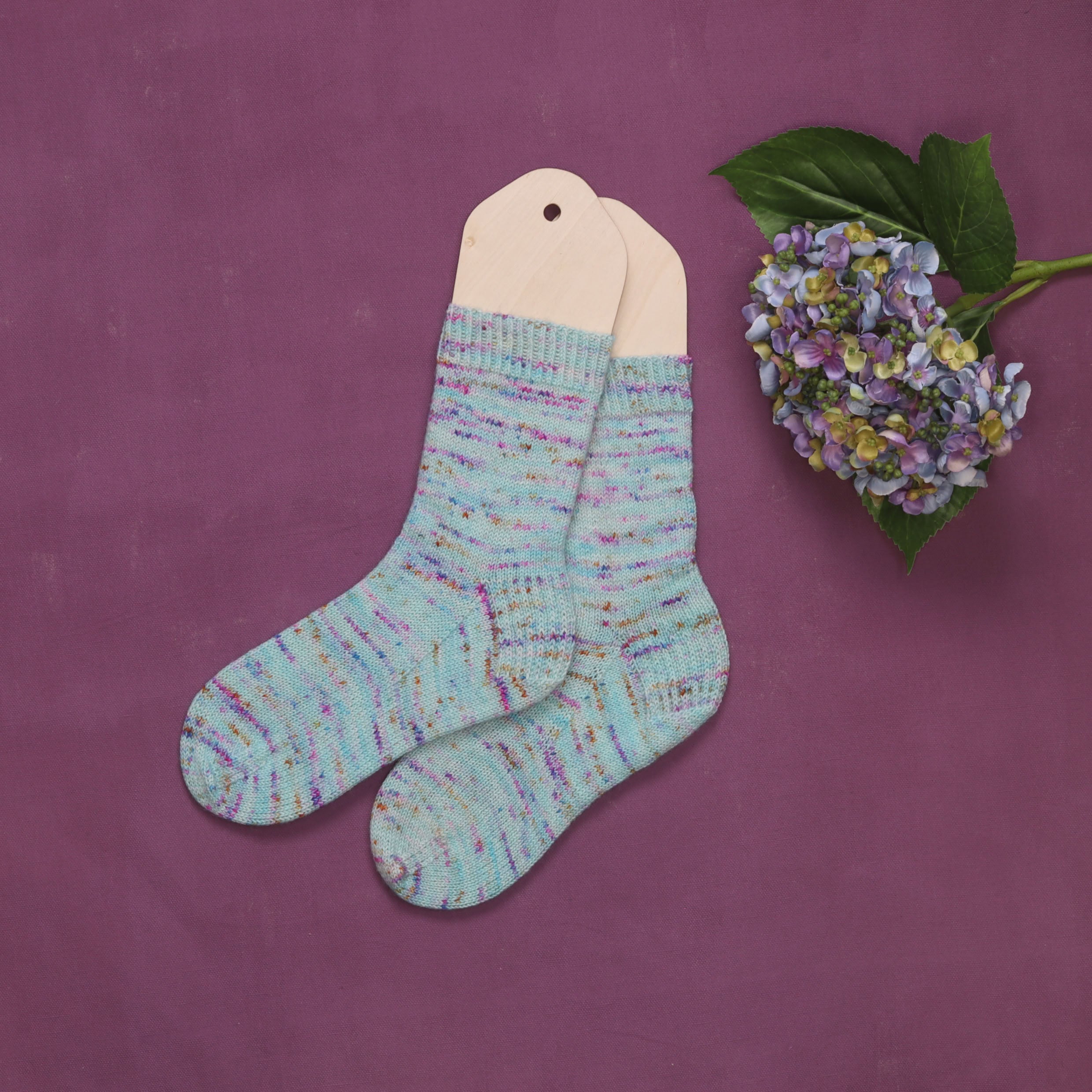

There is no single right needle for socks. I can prove it. I asked three of the sock knitters here what they use, and got three different setups from three people who have all been doing this for years.
What is interesting is not that they disagree. It is why they disagree, because their reasons are all about hands and habits rather than about which needle is better. That makes the choice much easier to make for yourself.
If you are new to needles generally, start with which knitting needles should you buy, which covers the four types and what each is for. This post is only about socks.
The three methods, quickly
A sock is a small tube, and a small tube is awkward. There are three common ways to hold it.
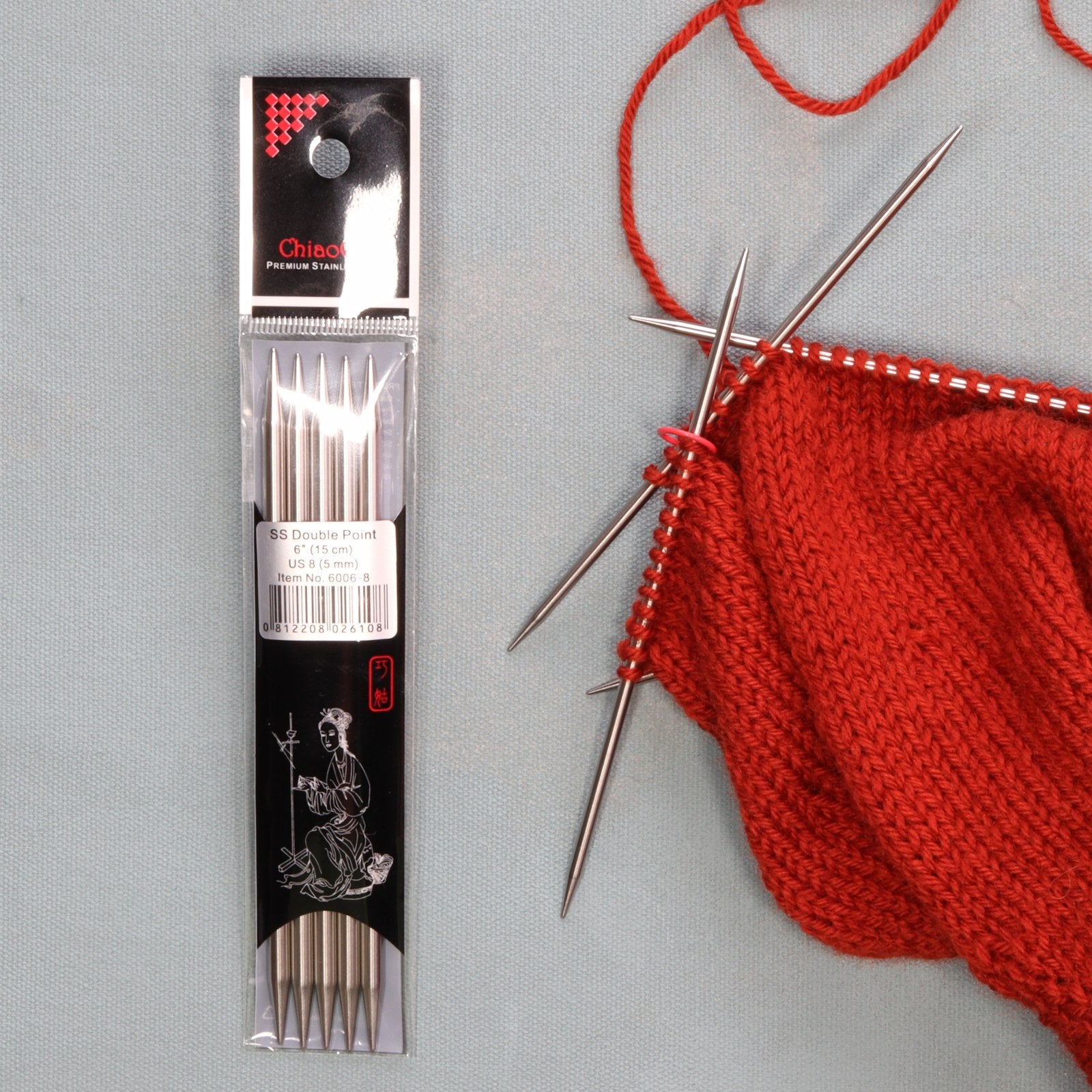
- Double pointed needles. Four or five short needles, the stitches divided between them, one spare to knit with. The traditional method.
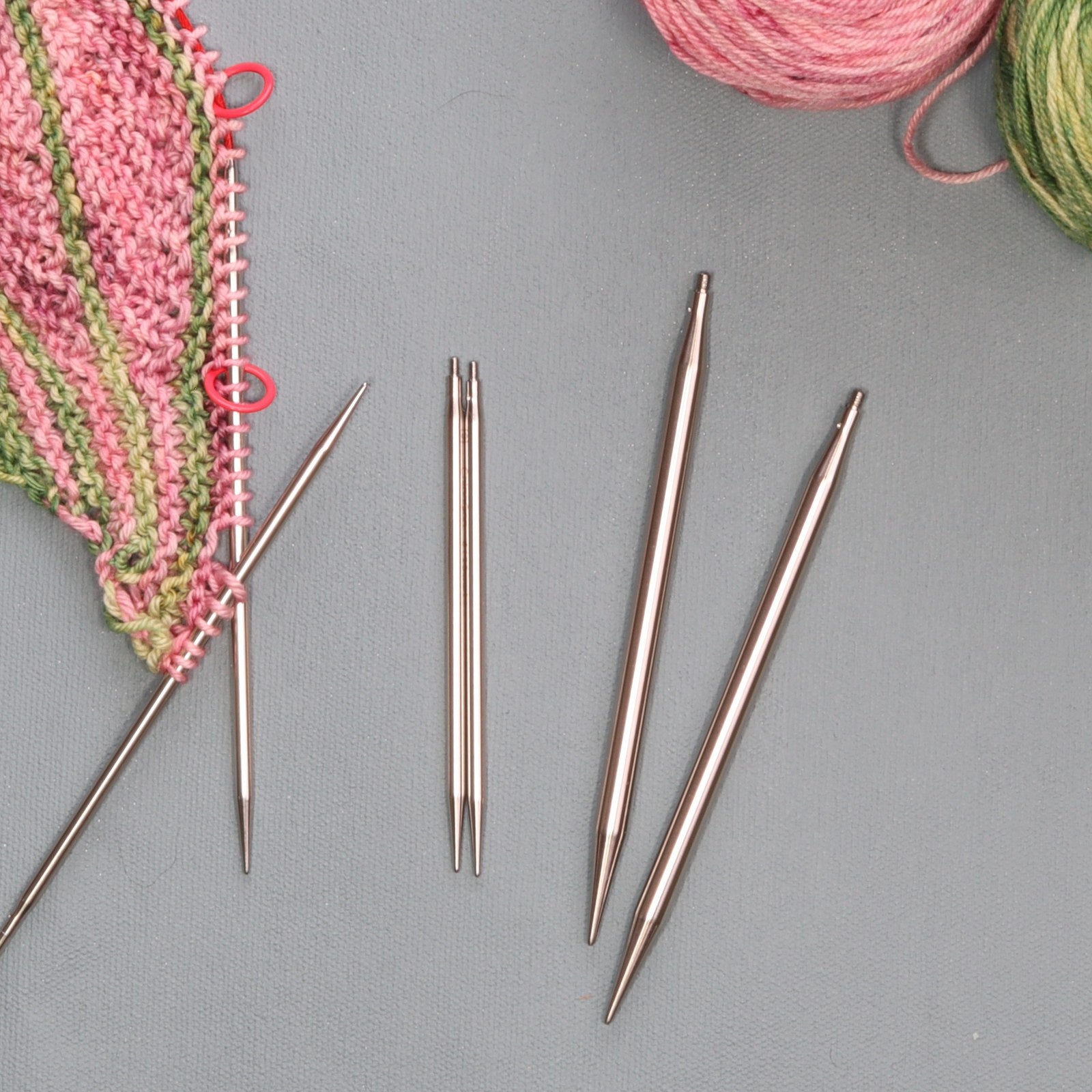
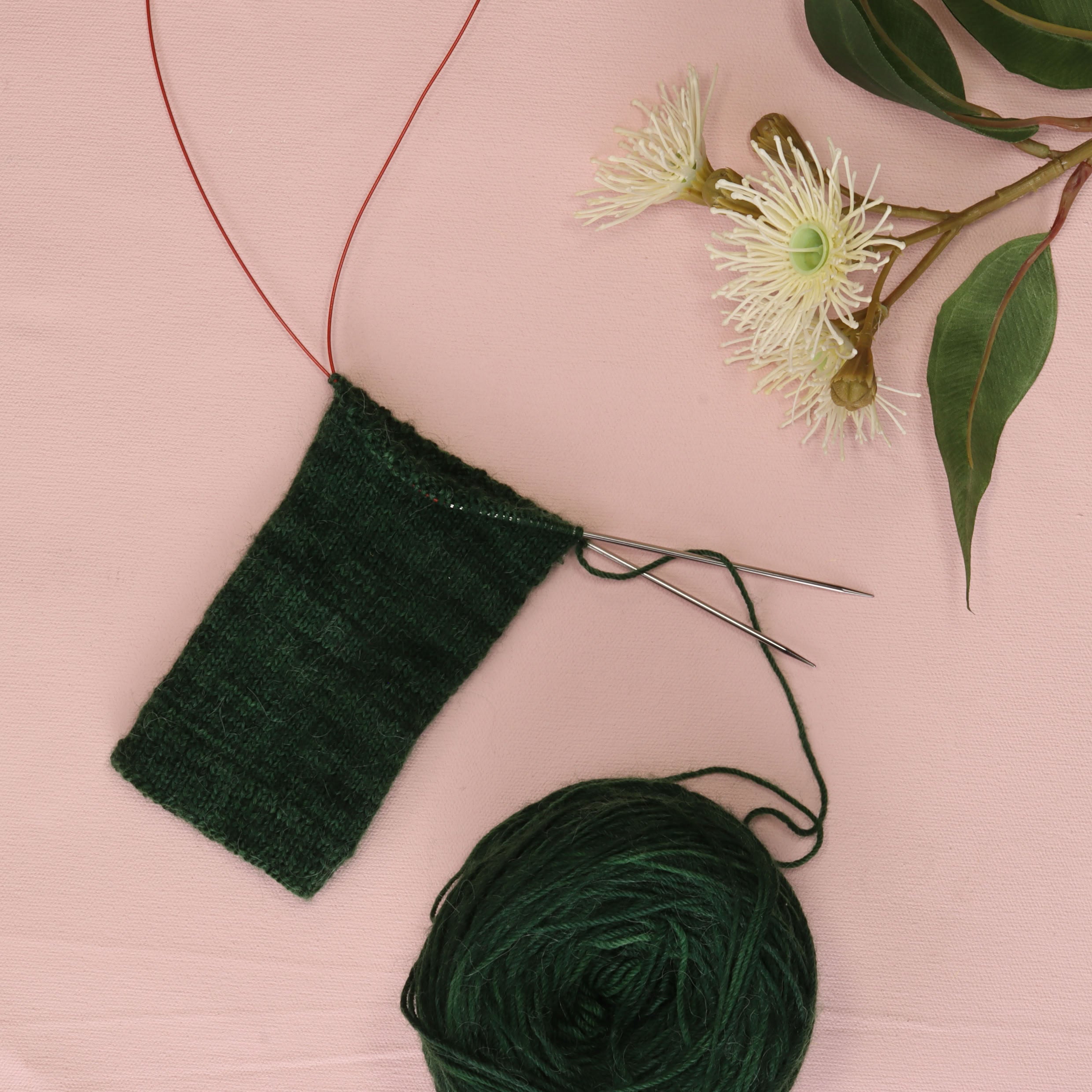
- Magic loop. One long circular needle, the stitches split into two halves, with a loop of cable pulled out at each side. A 100cm cable is the perfect length for it.
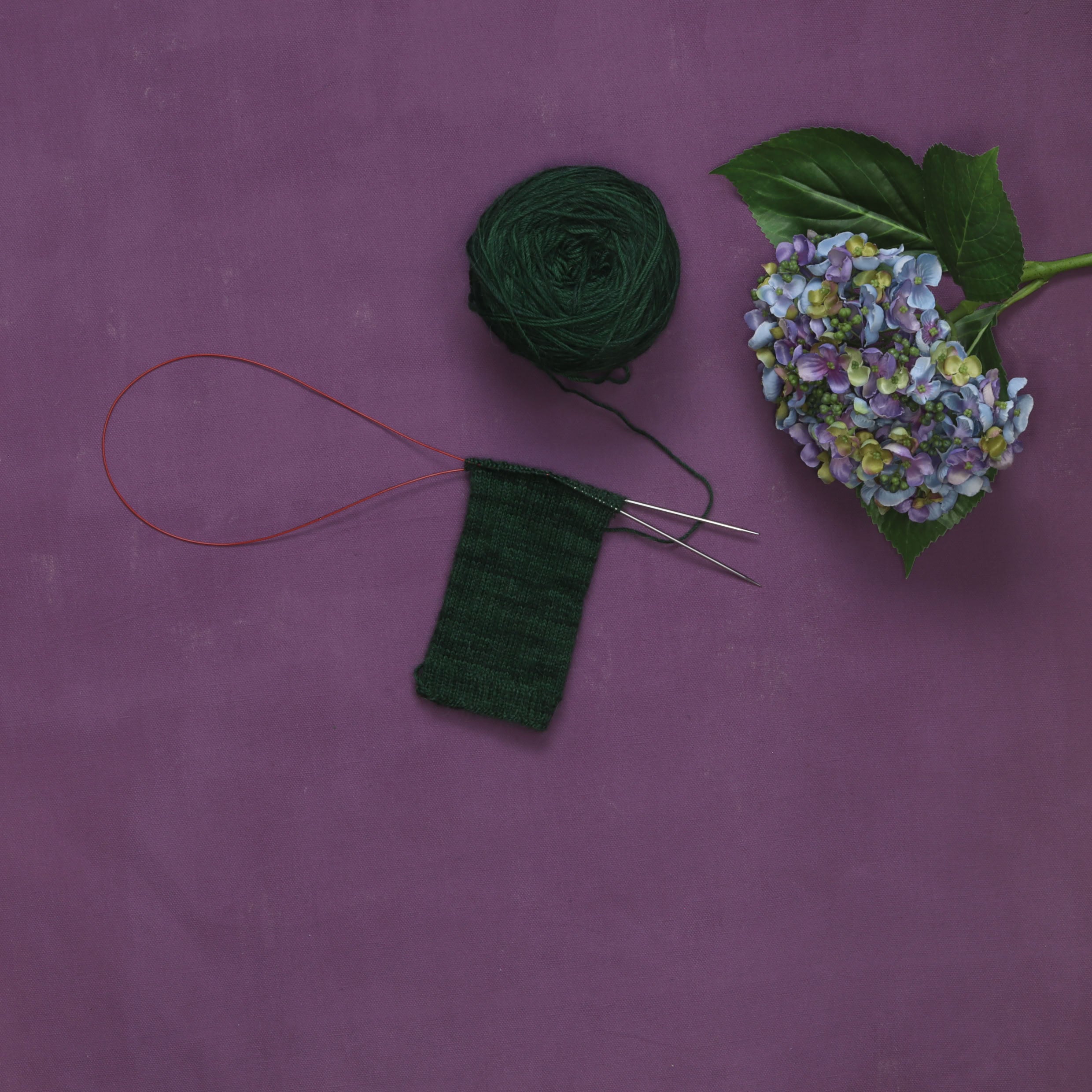
- A 23cm circular. A tiny fixed circular needle just small enough to go round a sock, so you knit round and round with no rearranging at all.
Helen knits on a 23cm circular
Helen started on magic loop and moved away from it. She is very clear about why.
"I've done magic loop and that's how I started off knitting socks, and I'm quite comfortable with that," she said, "but it slows you down so much, because you spend half your time pulling the cord through. So now I just use a 23cm circular needle."
And then, happily: "I just go round and round."
The catch is the needle tips, which are very short. I asked how she copes. "It is strange at first, because instead of using your whole hand to knit, you're just basically using your fingers. So you have to get used to it. But once you get used to it, it's so much faster than any other method, I find."
When I asked what she wished someone had told her before her first pair, this was the answer. Not a technique, not a yarn - "probably to use the 23cm circulars."
Janine knits with magic loop
Janine tried the small needles and they did not suit her, for a reason worth knowing about before you spend money.
"If I try and just use the really tiny needles, my hands are too big," she said. "I can't get tension properly."
This is the honest limit of the 23cm circular. Those tiny tips reward small hands and a light grip, and if yours are larger you spend the whole sock fighting for control of a needle you cannot properly hold. It is not a skill problem and practice does not fix it.
So she uses magic loop at 2.25mm, and the part she raves about is the cable. "I do love the ChiaoGoo cables," she said, and when I asked whether she uses the mini: "Yeah, the mini cable for the 2.25. That just rocks."


A 23cm circular (left) and magic loop (right) - the same job, two completely different ways of holding it.
Olga has tried them all
Olga does not have one answer. She has a rule.
"I'll try them all," she said. "It depends on what sock I'm doing." Specifically: a 23cm circular for colourwork, "because I don't have to move, I can just go round and round and it's a no-brainer". But if there is a lot of purling in the pattern, the little needles come out and magic loop goes back in.
She has even used double pointed needles for the heel alone, and still came back. "I've tried them all, but I think I still go back to magic loop. I like magic loop."
Her preferences are precise. They are the most useful thing in this post if you are choosing needles.
- Pointy tips. "I like the ChiaoGoo needles that are really pointy."
- Not a fixed circular for magic loop. "I don't like the fixed ones, because the cable's a bit too thick."
- Using a mini cable. "I like using the mini cable, because I find I don't get the laddering on the side, and it's just easy to do once you get into the rhythm of it."
That middle point is the one people get wrong. Magic loop asks the cable to fold back on itself twice, and a stiff cable fights that and drags at the stitches on either side of the fold. The soft mini cable is why Olga and Janine both stopped getting ladders.
I like using the mini cable, because I don't get the laddering on the side.
They all chose the same brand
I did not set out to push one brand over another. I asked all three the same question. All three said ChiaoGoo, for three different reasons - Helen for the 23cm fixed circular, Janine for the mini cable, Olga for the pointy tips and the mini cable together.
Here is what each of them is actually using.
| Helen | Janine | Olga | |
|---|---|---|---|
| Method | 23cm fixed circular | Magic loop | Both, depending on the sock |
| Needle size | 2.5mm | 2.25mm | 2.25mm |
| Why | No rearranging, and it is faster | Small needles do not suit her hands | 23cm for colourwork, magic loop for purling |
| The kit | Red Stainless Steel Fixed Circulars | TWIST Red Lace tips and a Mini cable | The same tips and Mini cable, plus a 23cm |
What size needles for a 4ply sock?
Two of the three use 2.25mm and one uses 2.5mm.
Helen: "I always use 2.5mm even if the pattern says 2.25mm. I found the fabric a bit too dense with my knitting style. I've also used 2.75mm and I think that's a bit loose. So just for me, 2.5mm is right."
Olga is at 2.25mm and likes it firm - "and it's quite tight", at around 28 stitches to 10cm.
They are each following their own hands rather than the pattern. Both know their number well enough to cast on without thinking. That is what you are aiming for, and you get there by knitting socks rather than by reading about them.
Socks want a firmer fabric than a jumper, because a loose sock wears through and goes baggy in the shoe. If your fabric feels floppy, go down a size. If it feels like knitting cardboard, go up. Helen's description of what you are after is as good as any: "not too tight, not too loose, just right."
One honest warning from her, about fibre rather than needles: a possum blend pair she knitted at 2.5mm came out too stiff to enjoy putting on. They sit in the drawer. Beautiful and warm, but a firm fabric in a dense fibre gets stiff quickly. A regular sock yarn is the forgiving choice.
Olga's top tips
Both of these are about fabric rather than needles. Both came out of her working on the same problem for years.
Purl through the back loop in your ribbing. "I found it a little bit sloppy when you're doing knit 3, purl 1 - all the purls were really sloppy. So I do a purl through the back loop and it looks really nice." A single purl stitch between columns of knit stitches tends to sag; working it through the back loop twists it closed and tidies the whole cuff. "Little things that you tweak, and it feels a lot better and it looks a lot better on."
Use the rib to change the fit. Olga knits for two sons, one with a wide foot and one with a narrow foot. She casts on exactly the same number of stitches for both. The difference is the stitch pattern: a knit 3, purl 1 rib stretches more, and a plainer fabric hugs more. Same sock, same numbers, two different fits.
Some quick answers
What size needles do I need for 4ply socks?
Start at 2.25mm or 2.5mm and let your own tension decide. Sock patterns usually specify 2.25mm, but one of our three sock knitters does not follow that - Helen goes up to 2.5mm because her fabric is otherwise too dense. You want a firm fabric that is not stiff.
Magic loop or double pointed needles for socks?
Magic loop, if you are choosing one to learn. All three of our sock knitters use it or have used it, and none of them knit a whole sock on double pointed needles - Olga uses them for the heel occasionally and that is all.
What is a 23cm circular and is it worth it?
It is a very small fixed circular needle, just big enough to go round a sock, so there is no rearranging at all - you knit round and round. Helen swears by it and says it is the thing she wishes she had known about. The catch is the very short tips, which suit smaller hands. Janine cannot get proper tension on them.
Why do I get a ladder of loose stitches down the side of my sock?
Laddering happens at the join, where you swap from one needle or one half of the cable to the other. On magic loop, a stiff cable is usually the culprit - it does not want to fold and it pulls at the stitches either side. A softer mini cable fixes it for both Olga and Janine. Knitting the first two stitches after each join a little firmly helps too, and so does moving the join - shift it along by a stitch or two every couple of rows so the strain never falls in the same place twice.
Do I need a special sock needle set?
No. A single 2.25mm or 2.5mm circular on a 100cm cable is enough to knit socks by magic loop. Buy one, knit a pair, then decide what you actually want.
Come and hold a few
If you can get to the shop, come and hold a 23cm circular before you buy one - you will know within about 30 seconds whether your hands are going to get on with it.
Our knitting needles are all here, and if you are still at the very start, how to knit your first pair of socks is the place to begin.
Much love and happy making,
Debx