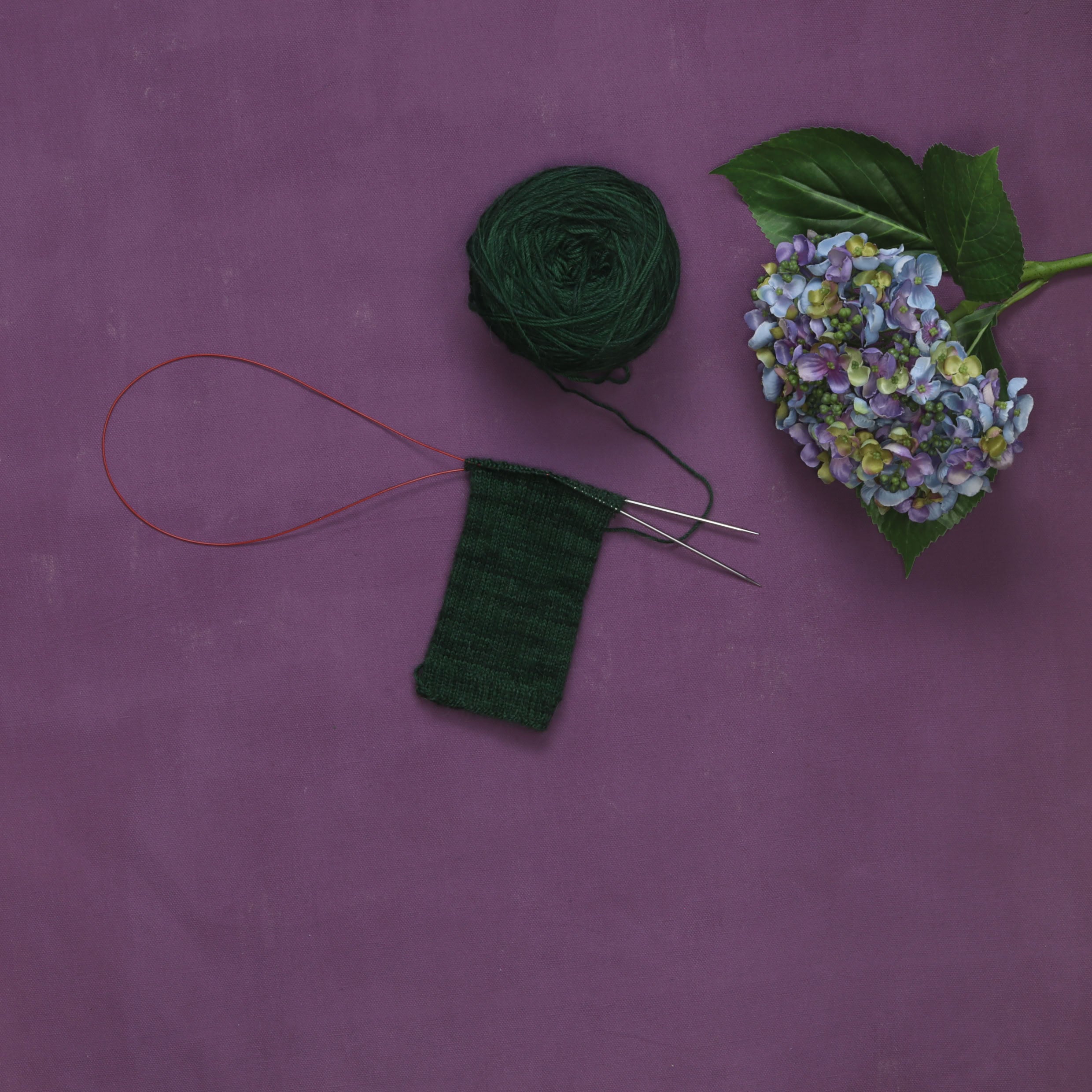
I don't knit socks. I've admitted that before and it is still true. When somebody in the shop asks whether they should knit top down or toe up, I generally say that each has its own pros and cons - but for a proper answer I go and find one of the people here who knits socks all the time.
This week I asked three of them the same question: my sister Helen, Janine and Olga. I got three different answers, and not one of them hesitated for a second.
Helen knits toe up, so she can try it on
Helen starts at the toe every time, and her reason is entirely practical.
"I can try on the foot as I go," she said, "because my family have big feet, and so it's very important that I can knit the right length foot."
That is the whole argument for toe up in one sentence. You knit the foot first, you slide it on and you stop when it fits. Nobody has to guess.
It also solves the other thing that worries people, which is running out of yarn halfway up the second leg. Helen weighs the ball before she starts, works out what half of it comes to and knits to that number. If the ball comes in at 104g, she knows she has to finish the first sock at 52g. Then she keeps weighing as she goes and stops the leg when she gets there. "I do my heel, and then I can knit the leg as long as I need, depending on how much yarn I've got left."
And there is a third reason, which made me laugh because it is so honest. Toe-up socks usually start with a cast on rather than finishing with a graft. "I hate grafting," Helen said, "because I hate doing anything with a sewing needle." She uses Judy's Magic Cast On instead: "you cast on and then you suddenly have this little toe that's there, and there's no sewing."

Olga knits top down, because of the instep
Olga goes the other way, and her reason is about the shape of real feet.
"I like it because when you're casting on, it's a nice stretchy cast on and it fits better," she said. "I find my instep is quite big, and my boys' too."
An instep is the arch on the top of your foot, between the ankle and the toes, and it is the bit a sock has to stretch over to get on. If the people you knit for have a high one, a stretchy cuff cast on and a heel flap and gusset make the difference between a sock that goes on and a sock that fights you.
"For the people I knit for, they've got higher insteps and it's hard to get it around their foot," Olga said. "It just works really well and I don't really have to think about it too much."
Janine knits top down too, but for a completely different reason
Janine's answer had nothing to do with feet. It was about the pattern.
She knits Helen Stewart's socks almost exclusively, and it is the way they are written that keeps her there. "She writes them so that you can see line by line where you're up to in the pattern," Janine said. "For me, that's a good way of keeping track."
The construction suits her as well. "For the most part, in her socks, she does a proper turned heel with a good gusset. So I find her socks fit really well." If you want to see what she means, Flourish Socks, Letterpress Socks and Bookbinder Socks by Helen Stewart are all on Ravelry, and there is a lace or a small cable in most of them.
It is worth noticing what happened there. Janine did not choose a direction and then find patterns to match. She found a designer she trusts, and the direction came with her.

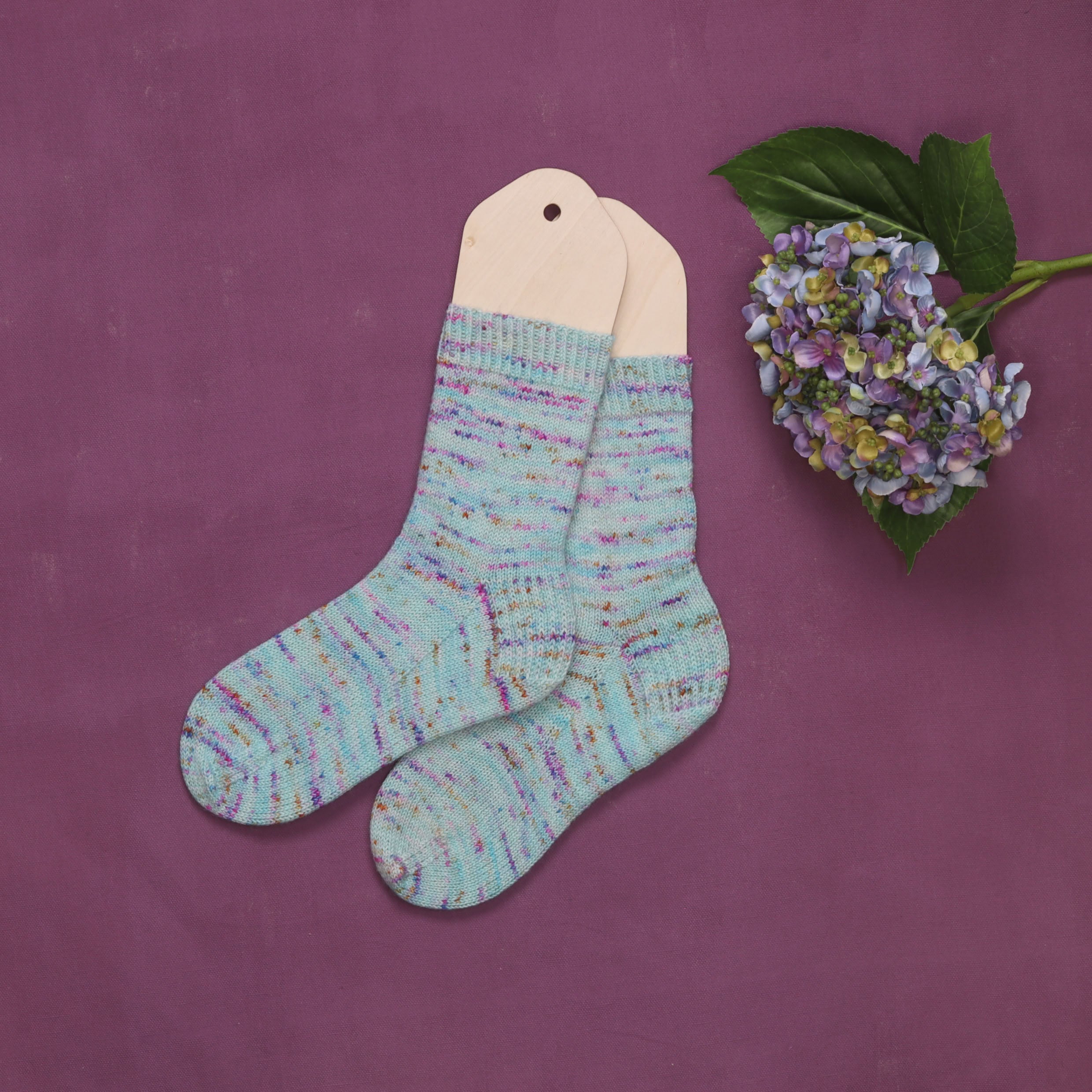
Curling Mist Socks by Helen Stewart.
So which one is easier for a beginner?
Neither. I asked Helen and Olga and they both said the same thing.
Olga first: "When you're starting socks, it's a hard thing anyway. So whether you're starting toe up or top down, you still have to think about the construction. It's much of a muchness."
Then Helen, when I put it to her that people say top down is the beginner's version: "I think it's just what people say."
There is a lot of confident advice online about which direction beginners should start with. Two of the most experienced sock knitters I know do not agree with it. The construction is the hard part, and you meet it in both.
Whether you're starting toe up or top down, you still have to think about the construction. It's much of a muchness.
How to actually choose
Here is what actually differs between the two.
| Toe up | Top down | |
|---|---|---|
| You start | At the toe | At the cuff |
| You finish | At the cuff | At the toe |
| Trying it on | Easy - the foot is finished first | You reach the foot late |
| Running out of yarn | Weigh the ball and stop the first sock at halfway | Decide the leg length before you start |
| The finish | A stretchy cast off at the cuff | Usually grafting at the toe |
| Choose it if | You are knitting for big feet, or you have one skein and no spare | You are knitting for a high instep, or you have found a pattern you love |
The last row is the one I would weigh most heavily. Top down is the traditional route and the one most older patterns use, so if you fall in love with patterns before you fall in love with techniques, that is worth knowing.
The bit they did agree on
Learn both, eventually. Not on your first pair, and not on your third, but at some point - and then use whichever suits the pattern, the yarn you are working with, or simply the one that feels most comfortable at the time.
Helen does exactly that. She likes knitting things with different techniques in them, but when she just wants a plain sock to show off a variegated skein, she casts on toe up without thinking, because that is the one her hands know best.
Some quick answers
Is toe up or top down better for a beginner?
Neither is easier. You have to understand how a sock is built in both directions, and that understanding is the actual work. Choose on fit and yarn instead: toe up if you want to try it on as you go or you are worried about running out, top down if you are knitting for a high instep or the pattern you want is written that way.
Do I need a special cast on for toe-up socks?
You need one that starts a closed toe rather than an edge. Judy's Magic Cast On is the one Helen uses and the one most toe-up patterns call for. Your pattern names the one it wants.
Can I run out of yarn knitting top down?
Of course you can, and it always happens on the second foot, just before you are about to finish. Decide your leg length before you start rather than knitting until you feel like stopping, and weigh your yarn as you go. And if you are worried you do not have quite enough, knit the heels and toes in a contrasting colour or a mini skein - it looks deliberate and it buys you all the yarn you need.
Does the heel fit differently depending on the direction?
The direction matters less than the type of heel. A heel flap and gusset suits a high instep, and a short row heel is neater and shallower. There is a lot more to say about that, which is why the heel has a post of its own.
Which direction do I need for self-striping yarn?
Either, but they look different. Knitting in opposite directions from the same ball puts the stripes in a different order on each sock, so if you want a matched pair, work both socks the same way from the same point in the colour sequence.
Come and ask us
If you are hovering between the two and can get to the shop, come in. There is almost always someone here with a sock on the needles, and they are all quite happy to chat to you. You will get at least two opinions, which is really the honest answer to this question.
If you have not cast on a sock at all yet, start with how to knit your first pair of socks, which covers the yarn, the needles and how much you need. And when you are ready to choose, our 4ply sock yarn is where most people begin.
Much love and happy making,
Debx