
Crochet is an extraordinary craft, and it deserves good tools. There's a lingering idea that it's the cheap and cheerful one – that you should make do with cheap yarn, cheap hooks, whatever's in the bargain bin. We'd like that idea to go away.
That matters most when you're learning. You're already working hard at the technique. You shouldn't have to fight the hook as well.
Why the handle is the whole thing
The single biggest change in crochet hooks over the last twenty years is the ergonomic handle, and it is absolutely worth it – for everyone, not just for people with sore hands.
A traditional hook is a thin metal shaft all the way along. It works perfectly well, and there's nothing wrong with it – I have a whole collection of my grandmother's and my mother's old hooks with plain straight shafts. But because it's thin, you grip it harder, and after a couple of hours of crocheting your hand knows about it. A fatter, softer handle lets your hand relax around it.
We still stock the plain ones, because some people genuinely prefer them. But if you've never tried an ergonomic handle – whether you're a complete beginner or you've been crocheting for forty years – give one a go. I'd never go back.
Which crochet hook should you buy first? A Clover Amour. The ergonomic handle is soft and easy to hold, it's long enough to suit a large hand, and the tip is just pointy enough to slip into tight stitches. If you buy one hook, buy that one.
Our top three favourites
Clover Amour – our first pick
The Clover Amour is the one we reach for. The handle is soft, easy to hold, and importantly it's a good long length. I'm 178cm tall with fairly large hands, and a lot of hooks stop partway across my palm, which feels uncomfortable the whole time I'm using it. The Amour has a long handle that fits right across my palm – and even if your hands are smaller than mine, it's still super comfortable to use.
The tip is the other reason. It's slightly pointy, so it goes into a stitch easily – and that matters much more than people expect, especially when your tension is tight or the stitch is small.

Clover Soft Touch – the same hook, a different grip
The Soft Touch has exactly the same tip as the Amour. The only real difference is the handle: brown rather than coloured, and a little flatter in the hand.
Which one suits you is genuinely just a matter of which feels better to hold. If you're anywhere near the shop, pick up both and you'll know in about five seconds.

KnitPro Waves – excellent, and a little cheaper
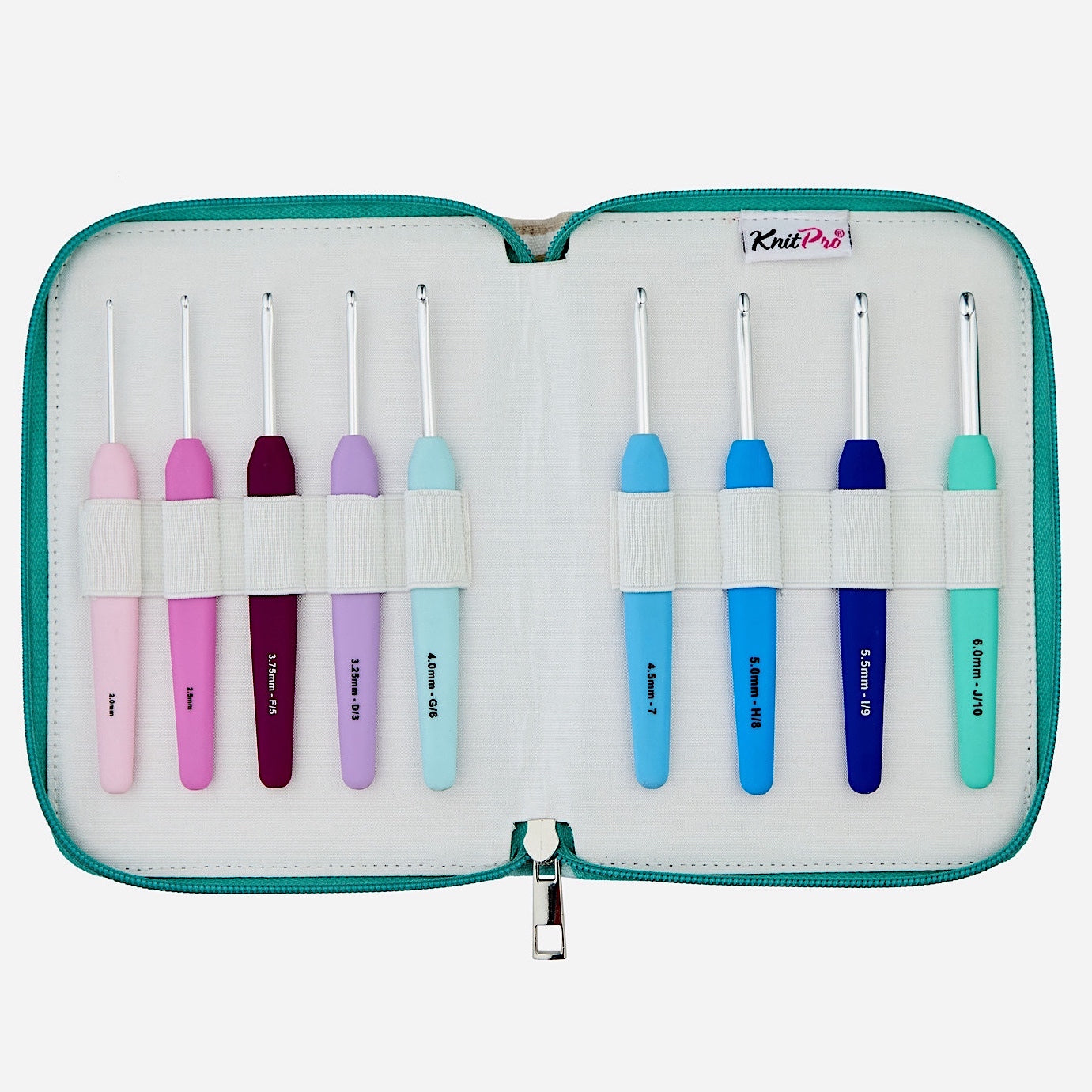
The KnitPro Waves is a very good hook with a comfortable handle, and it costs a bit less. The difference is at the tip: it's more rounded than the Clover. It glides into a stitch beautifully when the stitch is a bit looser, but it's not as easy to get into tight ones.
If your budget is the deciding factor, the Waves is a genuinely good hook and you won't be disappointed. If it isn't, the Amour tip is worth the difference.

What size hook should you start with?
The hook depends on the yarn, so the simplest answer is to start with a yarn we know works and use the hook that goes with it. These are the two combinations we suggest most often.
Fiddlesticks Finch with a 4.5mm or 5mm hook. Finch is a smooth 10 ply cotton and it's the one we most often put in a new crocheter's hands. Cotton shows your stitches clearly, which matters enormously while you're learning – you can see exactly where the hook needs to go. Our TLC Blanket Kit is built on it and designed for precisely this.
Fiddlesticks Peppin 14 with a 6.5mm or 7mm hook. This is what we use in our Beginner Crochet class. It's a bulky Australian merino, so the stitches are big and obvious and the work grows quickly – which is enormously encouraging in your first hour.
Either is a lovely place to begin. Choose the cotton if you want to see your stitches clearly, the wool if you want speed and squish.
Aluminium, or wood?
Aluminium is the all-purpose choice and it's what most hooks are. It's smooth, it's fast, and it does everything.
Wood – like the KnitPro Symfonie – is smooth too, but being wood it has a little more grip. That's exactly what you want with a slippery yarn, and cotton is the obvious one. If you're making something in cotton and the stitches keep sliding around on you, a wooden hook is worth trying.
It's the same principle as knitting needles, where bamboo grips a slippery yarn better than steel. If you're curious about that side of it, our guide to choosing knitting needles goes into it.
The one place this really bites is Tunisian crochet, where nearly every hook on the market is bamboo or wood. For Tunisian, where you're holding a whole row of loops on the hook, that grip can be more of a hindrance than a help. We're on the hunt for beautiful metal Tunisian hooks – watch this space.
What about the shape of the hook itself?
You'll find people online arguing fiercely about inline versus tapered hook heads. In nearly ten years of running a yarn shop, nobody has ever asked me about it. They may well be thinking it, but it's not what people come in worrying about.
The thing that actually matters is the shaft just behind the hook, because that's what forms the stitch and sets its size. You want that section to be even. A hook that tapers sharply right behind the head makes it harder to form stitches of a consistent size, which is the opposite of what you want.
Should you buy a set?
Eventually, yes – and for exactly the same reasons as knitting needles. Having the whole range means that when you swatch you can go up or down a size without another trip to the shop, which is the whole point of swatching.
Sets come in different ranges. A smaller set covers the sizes most people use most of the time; a larger one gives you a much broader spread. The KnitPro Waves set, for instance, comes as a Deluxe of nine hooks or a Grande of fourteen. There's also the Clover Amour set if you already know the Amour is your hook. See all the sets.
But if you're just starting, buy a single hook first. Find out which type you actually like in your hand, then invest in a set of that.
And here's the part nobody tells you: there is nothing wrong with owning two of the same size. If you fall properly in love with crochet you'll have several projects on the go at once, and keeping a 4mm hook in each project bag is far better than pulling it out of one thing to use on another and then forgetting what size you were on. I have two 4mm hooks and I'd happily have three.
UK or US terms?
People sometimes expect hook sizing to be the tricky bit. It mostly isn't – patterns these days are generally written in millimetres, and where an American pattern gives you a letter instead, our hook, needle and yarn guide has the conversion.
The real one in crochet is UK versus US terminology. The two systems use the same stitch names to mean different stitches, so a pattern written in US terms and read as UK terms will not give you what the picture shows. It's worth checking which set of terms your pattern uses before you start.
The good news: it makes no difference at all to which hook you buy. Terminology changes the instructions, not the tool.
Common questions
What size crochet hook should a beginner start with?
It depends on the yarn. With Fiddlesticks Finch, a 10 ply cotton, use a 4.5mm or 5mm hook. With Fiddlesticks Peppin 14, a bulky wool, use a 6.5mm or 7mm – that's the combination we teach with in our Beginner Crochet class, because the bigger stitches are easier to see.
What crochet hook should a beginner buy?
A Clover Amour or a KnitPro Waves. Both have a comfortable ergonomic handle from the first row and a length that suits most hands. The Amour's tip is slightly more pointed, which makes getting into stitches easier while you're still finding your tension, but the Waves is an excellent hook and a little kinder on the wallet.
Are ergonomic crochet hooks worth it?
Yes, and for everyone rather than just people with sore hands. A thin metal shaft makes you grip harder, which is what tires your hand out over a long session. A softer, fatter handle lets your hand relax.
Aluminium or wooden crochet hooks?
Aluminium is the all-purpose choice and suits almost everything. Wood has a little more grip, which helps with slippery yarns such as cotton.
Should I buy a crochet hook set or single hooks?
Buy one hook first and find out what you like in your hand. Once you know, a set is worth it – you can go up or down a size when you swatch without buying another hook.
Does it matter whether a pattern uses UK or US terms?
It matters a great deal for the instructions, because the same stitch names mean different stitches in each system. It makes no difference to which hook you use.
Come and hold a few
Hooks are entirely a matter of what feels right in your hand, and you'll know within seconds. If you're near Dulwich Hill, come in and try an Amour, a Soft Touch and a Waves side by side – it's the fastest way to decide. If you're not local, tell us what you're making and we'll point you at the right one.
Debx